
Across Massachusetts and the country, businesses and nonprofits alike are grappling with dramatic political shifts and economic volatility—testing the resilience of our leaders, workers, and communities like never before. Over the last few years, companies and organizations have faced a barrage of challenges—from layoffs and inflation pressures to a changing policy landscape that often frames nonprofits and businesses as adversaries. The reality is exactly the opposite: the health and vitality of the business and nonprofit sectors are deeply connected.
Too often, the relationship between these two sectors is viewed through a narrow lens of transactional giving—the business gives, and the nonprofit receives. This outdated, oversimplified model fails to capture the immense power of true collaboration. We must move toward a model of reciprocity where both sectors can leverage their unique strengths to meet the current moment through supporting communities and building a more robust economy.
The mutual benefits of cross-sector collaboration are most visible in the way we develop our most valuable asset: people. In Massachusetts alone, the nonprofit sector employs 550,000 people, representing 17% of the commonwealth’s workforce. This sector is not just a social safety net—it is a critical economic engine for our communities, from healthcare and education to workforce development and housing. In turn, these systems support the businesses that call those communities home.
While businesses often excel at innovation and large-scale efficiency, nonprofits are masters of community-centered engagement and navigating the complex social factors that impact an individual’s ability to thrive. Through thoughtful partnerships, including board service, volunteer projects, and workforce development, businesses can gain direct insight into the communities they aim to serve, while nonprofits gain access to operational expertise that can help scale their impact.
In exchanges like board service, the learning goes both ways. Business leaders provide vital oversight of strategic planning, risk management, and governance. In return, they gain a deeper understanding of collective action and sustainable growth under resource constraints—skills that are increasingly valuable in a volatile global market. Business leaders also gain a deeper understanding of the economic barriers community members are facing, allowing business and nonprofit collaboration to move beyond acts of charity, and toward empowering long-term, sustainable economic growth.
A shared commitment to core values like service and giving can strengthen the internal fabric of any organization, regardless of its tax status. The nonprofit sector has decades of experience embedding organizational values into daily operations, ensuring that assets like wellness and belonging are explicitly named and practiced with care. Businesses that are looking to strengthen their own company culture can learn a great deal from how nonprofits tangibly incorporate these values into their infrastructure. Thinking holistically about a company’s social impact isn’t just good for the community; it’s a competitive advantage that attracts and retains talent in a values-driven job market.
As we move forward in a world where headlines increasingly point to division and instability, the reality of our shared social and economic fabric encourages us to choose alignment and creative collaboration over isolation. The shared capacity of the business and nonprofit sectors holds the key to long-term prosperity for our nation. It is time for every business and nonprofit leader to move beyond outdated divides and commit to the shared work of building a brighter, more collaborative, and more prosperous future for all.
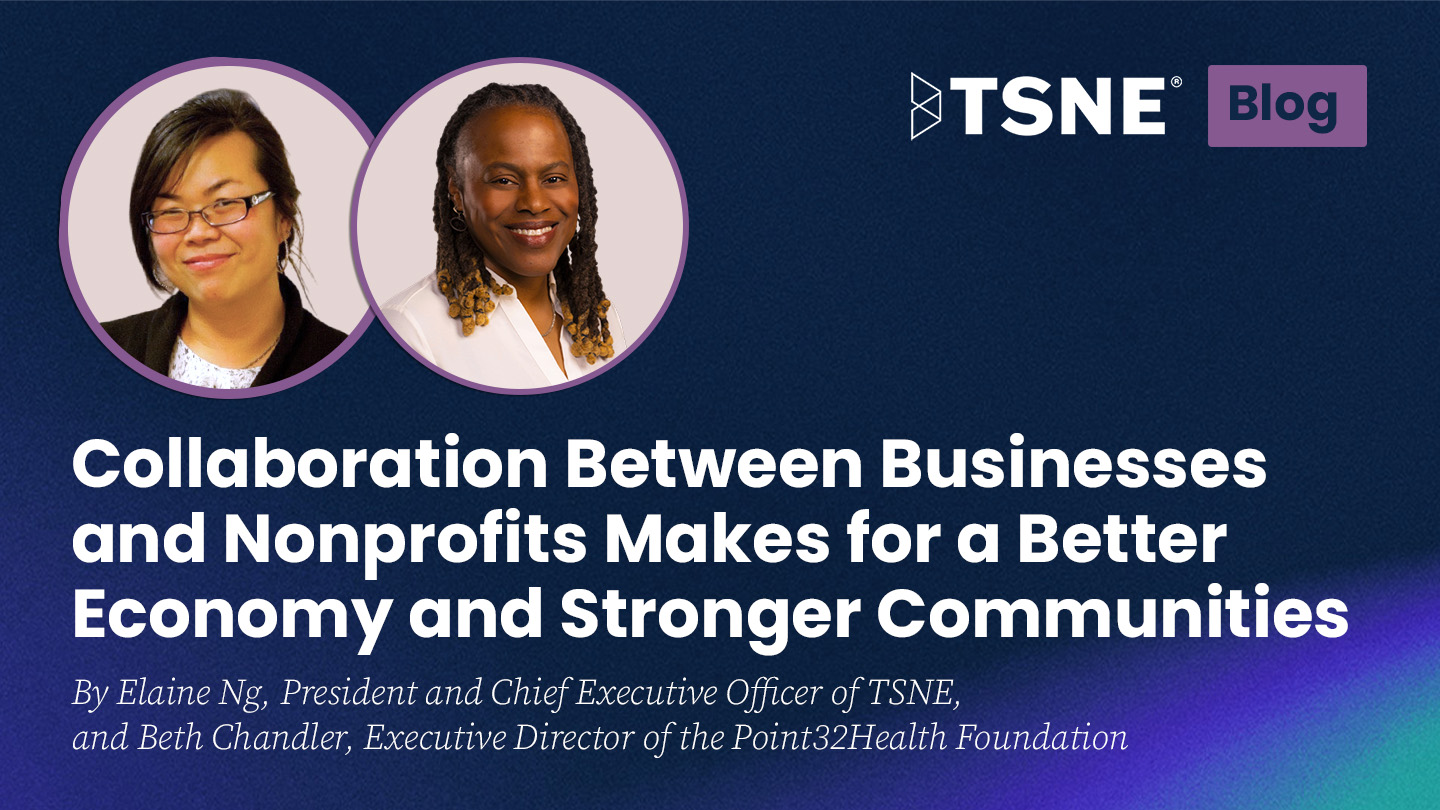
Elaine Ng is the President and Chief Executive Officer of TSNE.
Beth Chandler is the Executive Director of the Point32Health Foundation.