
Background
Every year, tax-exempt nonprofits file a Form 990 with the IRS to show how much money they’ve raised, how much they’ve spent, and who runs their organization. This form is the main public record of a nonprofit’s finances and governance, and it underpins the trust and transparency that donors, regulators, and the public have with charitable organizations State Attorneys General also use it to monitor nonprofit compliance and investigate potential fraud or mismanagement.
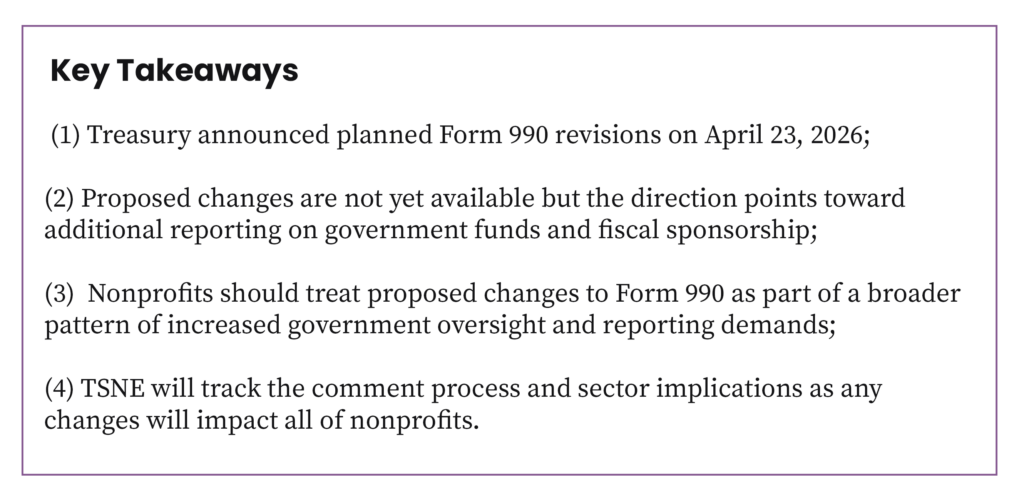
Congressional oversight has raised concerns that some fiscal sponsorship arrangements may obscure who is operating a project, who controls its funds, and how those funds are used. The Treasury’s April announcement that the IRS will revise Form 990 to require clearer disclosure in these three areas was their response to these concerns. The precise scope of changes to the Form 990 will not be clear until the Treasury publishes the proposed changes for public comment.
Recent congressional hearings and public remarks give a sense of where this is heading. On June 3 and 4, Secretary Bessent testified before the Senate Finance and House Ways and Means Committees. While both hearings focused broadly on Treasury priorities and the economy, nonprofit accountability came up repeatedly, including a further explanation of the new “Know Your Grantee” standard, modeled on banking’s anti-money laundering framework “Know Your Customer“. This standard could establish a framework of accountability for grantors, including the potential loss of their tax-exempt status, based on the actions of their grantees. Remarks from Chairman Smith of the House Ways and Means Committee also connected nonprofit accountability to a broader national security frame, stating that the nonprofit sector could serve as a channel for foreign influence operations, where rival nations fund domestic organizations to stir up internal division, turning oversight of nonprofits into a tool for countering foreign interference rather than simply enforcing tax compliance. This framing raises the political stakes and urgency around nonprofit oversight.
Even if the Treasury and the IRS move quickly, Form 990 changes typically take time to implement once announced, since both the form and its instructions must go through a rulemaking process. It is expected that the proposed changes will be open to the public for comment. This is not an immediate filing-season change, but it is one that nonprofits and their advisers need to track now.
Why It Matters
Fiscal sponsorship is a long-standing and widely used model in the nonprofit sector. It allows an established nonprofit, the fiscal sponsor, to support charitable projects to operate under its tax-exempt status. Tens of thousands of projects nationwide rely on this arrangement, from emerging grassroots groups to established programs that find shared infrastructure more efficient.
Fiscal sponsors are already registered nonprofits subject to significant oversight: they file public tax returns, maintain financial controls, undergo audits, and follow federal and state law; the projects they sponsor follow those same rules. Notably, a 2024 study by the Association of Certified Fraud Examiners found that nonprofits and non-governmental organizations reported the least amount of fraud than several other sectors including private companies and government, suggesting existing accountability structures are already working.
That said, this Form 990 announcement does not exist in isolation. Over the past year, fiscal sponsorship has come under sustained legislative and administrative pressure, including the following:
- Legislative threat: The SPONSOR Act, if enacted, would hold fiscal sponsors criminally and civilly liable for the actions of their sponsored projects, and would presume them responsible by default, requiring them to prove they exercised due diligence rather than placing the burden of proof on the government, which is how liability cases typically work.
- Increased federal scrutiny: The White House recently directed federal agencies to report detailed spending data on 49 specific nonprofits, and new fraud task forces and enforcement divisions have been created to target federally funded nonprofits.
- Broad new authority: This June the House passed the Stopping Fraudulent Payments Act and the Fraud Prevention and Accountability Act , which if it becomes law, would give federal agencies the power to freeze or delay grant payments to organizations deemed an “elevated fraud risk,” a standard vague enough to invite inconsistent or politically motivated application.
- Administrative burden: Reporting and documentation requirements are increasing across the board, landing at a moment when many organizations are seeing increased demand for their services and decreased funding, thereby limiting their bandwidth to absorb new compliance demands.
In practice, even well-intentioned transparency reforms, depending on design, could increase reporting burdens for fiscal sponsors, sponsored projects, and funders by requiring data they do not currently collect or report in this form. These expanded requirements will be administratively burdensome and time-consuming, which will take away time and energy from mission-driven work. Beyond the administrative burden, proposed changes to the Form 990 could invite government scrutiny based on legal wrongdoing but driven by whether the government agrees with the nonprofits mission and who they serve . That is dangerous under any government. The impact would fall hardest on smaller organizations, which often have limited capacity and serve some of the most vulnerable communities. Overall, this could discourage the use of fiscal sponsorship altogether, reshaping how billions of dollars in charitable funds are tracked and governed nationwide.