
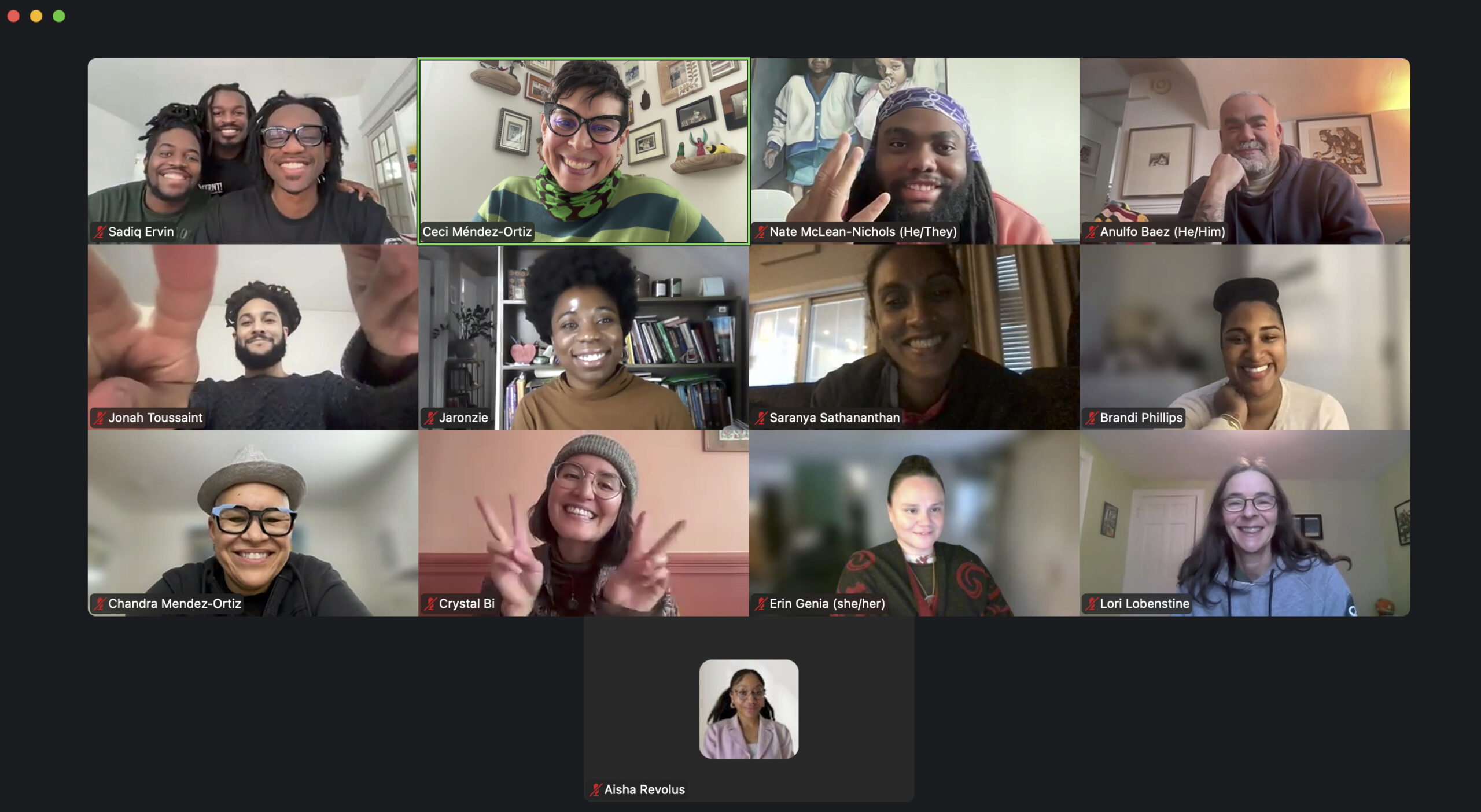
Photo: At a recent fellowship retreat, RIRJ staff and fellows gathered to discuss their collective work.
—
There is something quietly radical happening in Boston, and it is being led by artists. Not artists as ornaments, afterthoughts, or the creative layer added once policy and power have already been decided. But artists as infrastructure builders, organizers, and stewards of collective futures.
At the center of this work is Radical Imagination for Racial Justice (RIRJ) Boston, which receives fiscal sponsorship from TSNE. Since launching in 2020, RIRJ has been asking a bold, necessary question: What does it look like to support creatives of color in co-designing racially just futures with their communities — not for a moment, but for the long haul?
For Executive Director Ceci Méndez-Ortiz, the answer is rooted in care, trust, and courage.
Building New Worlds
“Radical imagination,” Méndez-Ortiz told us, “is about getting to the root of injustices while creating transformative alternatives that don’t yet exist. It’s a both/and. Not just identifying what systemic issue needs to be addressed but asking what new worlds there are to build. Radical imagination is about creating space to envision the futures our communities deserve — and trusting artists and culture bearers to lead the way.”
In Boston right now, that question carries weight: rising displacement, climate crisis, development pressures, the enduring legacies of colonization, and deep inequities embedded in who controls land, space, funding, and narrative power. RIRJ’s response isn’t to simply issue statements. It is to resource artists.
The current iteration of RIRJ’s work (the RIRJ Boston Fellowship) provides three fellows with $140,000 over two years. That $70,000 per year in flexible support is accompanied by cohort learning, technical assistance, partnerships, and a deep emphasis on artist well-being.
“This is substantial funding that allows for deep and sustained work,” Méndez-Ortiz shared. It gives artists time to build relationships, prototype ideas, experiment, and develop change that actually has a chance at being sustainable.”
And crucially, it centers dignity. “This fellowship is intentionally meant to support creatives to pay themselves,” she said. “To pay respectful artist fees. To give up a gig if they need to. To pay collaborators more equitably. This fellowship recognizes that the people bringing creative, collaborative, justice-oriented work need support and love too.”
Too often, what gets funded is the highlightable project, not the full cost of those doing the work. RIRJ flips that model. It trusts artists to decide what they need.
“If you’re entering a two-year project and you already know exactly what’s going to happen,” she reflected, “that’s not radical. The trust is in the artists to determine what needs to be done and to pivot over time.”
The Power of “We”
At a recent fellowship retreat, a single theme rose again and again.
“The collective ‘we’ was so strong,” she said. “How deeply all the fellows embody collective work and the power of we, and how fundamental that is to their understanding of racial justice.” Each fellow expresses that “we” differently. But the throughline is unmistakable: none of them are building for themselves alone.
Erin Genia
Erin Genia, a Dakota and Odawa artist and a tribal member of the Sisseton Wahpeton Oyate, is organizing gatherings of Native artists to reclaim traditional material practices such as pit firing, clay harvesting, weaving, and pipestone carving, while strengthening advocacy and tribal sovereignty. She is bringing together two strands of her life: Western fine arts training and Dakota governance, philosophy, and organizing. Erin’s work centers intergenerational connection, tribal protocol, and collective sovereignty. It asks what it would mean for Native artists in Boston to gather, learn, and build power together.
Dorchester Weather
Dorchester Weather is a neighborhood theater ensemble working with Black, immigrant, and working-class neighbors in Dorchester to reimagine the future of a contested city-owned vacant lot. Their project, The Lot Next Door, uses devised theater and role-playing games to address environmental racism, displacement, and harmful development. Their plays are built from neighbors’ memories, phone calls with city officials, stories, frustrations, and dreams. The art is not simply about the community — it is made with them. Dorchester Weather is also helping neighbors co-create a community-driven cumulative impact assessment, ensuring that residents themselves define what should be measured when evaluating infrastructure projects.
Nate Nics and Thrill
The team Nate Nics and Thrill is reimagining the funding ecosystem itself. Their proposed Reciprocal Artist Project (RAP Fund) adapts the West African and Caribbean sou-sou model to Boston’s creative economy. BIPOC artists would receive seed money to launch projects and then contribute back to fund the next creator in a rotating economy of support. Mentorship is woven in through a multi-generational “Thrill Council.” The aim is not just surviving but thriving. They envision a world where the descendants of the Black diaspora and people of color are the cultural and material determiners of their lives, where egalitarian, non-hierarchical cooperation is common, and decisions are not based on majority rule but consensus.
Artists As Builders
For Méndez-Ortiz, artists play a unique role in moments of social transformation. They can ask questions to develop solutions that policy alone cannot. They can make complex systems visible, challenge dominant narratives, and create space for people to imagine alternatives.
“Artists help us see what doesn’t exist yet,” she said. “Artists aren’t just storytellers. They’re architects of possibility.”
Creative practices allow communities to rehearse possibilities — whether through theater, storytelling, cultural traditions, or new economic models. That ability to imagine collectively is essential when confronting deeply embedded systems of inequality.
Artists also bring different orientations to change. Rather than focusing only on critique, they can help communities prototype new structures, relationships, and ways of living.
In that sense, the fellows supported through RIRJ are not simply producing art. They are experimenting with what more just systems could look like. RIRJ’s partnership with Design Studio for Social Intervention, which also receives fiscal sponsorship from TSNE, underscores these vital imaginings.
Across all three fellows, several themes echo:
- Collective power over individual genius
- Intergenerational connection
- Moving from scarcity to abundance
- Centering those most impacted
- Building systems, not just projects
“These artists are not just working within existing structures,” Méndez-Ortiz reflected. “They are creating new systems as alternatives to structures that have been extractive.”
RIRJ itself operates as a kind of prototype, learning from each cycle then adapting and refining. “We’re experimenting too. This fellowship is an iteration. We plan to learn from it and evolve.”
Nothing About Communities Without Them
Across each fellowship project, a shared principle emerged: communities are not audiences or beneficiaries. They are collaborators.
For Méndez-Ortiz, this distinction is essential. Too often, creative or philanthropic initiatives arrive with predetermined solutions, inviting communities to participate only after decisions have already been made. RIRJ’s model intentionally changes that dynamic.
“The work is not being done for communities,” she explained. “It’s being done with them.”
In each case, the process is as important as the outcome. Community members help shape questions, define priorities, and imagine possibilities. The result is work that reflects lived experience rather than outside assumptions.
Infrastructure for Radical Work
Radical imagination also requires infrastructure.
Projects like Radical Imagination for Racial Justice often operate at the edges of traditional funding and institutional systems. Fiscal sponsorship provides a way for visionary initiatives to build and grow without needing to create an entirely new nonprofit structure.
RIRJ is fiscally sponsored by TSNE, which provides operational infrastructure and support for mission-driven projects. Through fiscal sponsorship, TSNE manages administrative systems such as finance, compliance, and HR, allowing initiatives like RIRJ to focus their energy on community relationships, creative experimentation, and long-term vision.
For Méndez-Ortiz, that support creates breathing room: “Having strong infrastructure behind the scenes allows us to focus on the work itself: the artists, the community relationships, the vision for racial justice,” she said. “This connection with TSNE and being able to receive fiscal sponsorship has really enabled RIRJ to have an autonomy that we didn’t have before. All of these resources — from payroll and benefits to having an HR team I can go to at any time — have been transformational for me. TSNE is the reason, the link for us being able to continue this work. That has always been the goal: how do we keep bringing these resources to Boston creatives?”
Across the country, many innovative initiatives are emerging outside traditional nonprofit structures. Fiscal sponsorship can provide a flexible path for those efforts to grow while maintaining the agility and community-centered leadership that makes them powerful.
Meeting This Moment with Courage
In the face of political pressure and shifting federal landscapes, Méndez-Ortiz is clear that radical imagination requires boldness. “A big part of radical imagination is meeting this moment with courage,” she said.
RIRJ trusts artists experiencing injustice directly to define solutions. It refuses the idea that outside experts should dictate the future.
“This is radical because it challenges the dominant paradigm,” she said. “It’s the folks who want to make change for themselves and their communities who are leading.”
What Boston Could Become
RIRJ’s long-term vision is that BIPOC artists, creatives, and culture bearers are at the forefront of a racially just Boston.
These fellows are prototyping possibilities: If the RAP Fund works, could it scale? If community-driven impact assessments take root, could they reshape policy statewide? How might Indigenous governance principles inform broader democratic practice?
“Long-term change requires broad ownership,” Dorchester Weather has said. And broad ownership requires something philanthropy rarely offers: time.
Two years. Flexible funds. Trust. A cohort that asks, “How can we support you?” A space where artists are paid, valued, and treated as knowledge holders.
RIRJ is not simply funding art. It is investing in the conditions under which artists and their communities can imagine and build something different.
In a moment when fear and contraction feel pervasive, that investment matters. And in Boston, artists are gathering. They are reclaiming lots, honoring Indigenous governance traditions, and building reciprocal economies. They are asking not only what needs to be dismantled, but what needs to be built – and they are doing it together.
Learn more about Radical Imagination for Racial Justice’s work in Boston.
Learn more about TSNE’s Fiscal Sponsorship at tsne.org/fiscal-sponsorship.