

 Do you remember what it was like to wake up happy and excited to go to school? Remember when you really connected with an extraordinary teacher who appreciated your special interest in one specific subject? Do you recall the feeling of pride when you finished a particularly challenging assignment? If you remember those feelings, your teachers knew how to make classrooms into positive learning environments that foster joyful learning.
Blue Butterfly Collaborative (a fiscally sponsored organization of TSNE) is helping schools in Haiti create positive learning environments that support student learning.
Most classrooms in Haiti lack the kind of joyful energy that you remember. Eighty percent of teachers receive no pre-service training. With few opportunities for professional development around best practices in classroom instruction, Haitian teachers are left to rely on what they know, based on how they were taught, perpetuating an outmoded and ineffective approach to teaching and learning. Instruction is typically in the colonial language of French, which few teachers or students speak natively. Mainstream instruction emphasizes lecture, repetition, and rote memorization, resulting in an ineffective learning environment where students are often unengaged, and additional instruction time has no relationship to better educational outcomes.
There are many avenues to improve educational outcomes in Haiti. Blue Butterfly and its partners are addressing one lever for change: teacher pedagogical practice. Blue Butterfly’s Lakou Kajou project is helping Haitian teachers shift their mindset away from the instructional methods that are the norm, toward learner-centered approaches that engage students.
Meeting Students Where They Are
Most of Blue Butterfly’s partner schools lack internet access, reliable electricity, or the kinds of classroom technology common in North America. Yet rather than seeing limitations, Blue Butterfly sees opportunities for imagination and ingenuity.
“We use technology, but in a really appropriate and clever way,” explained Suzanne Cole, co-founder and co-executive director. “We see the value of technology to close gaps, build technical skills, and most importantly bring joy into the classroom.”
That often means focusing on audio-based learning, which requires less infrastructure than video. Songs, stories, and lessons are delivered via Bluetooth speakers controlled by teachers using mobile tablets. These simple tools transform the classroom environment—sparking energy, curiosity, and laughter.
Technology here isn’t the end. It’s the bridge.
“We’re not doing it for technology’s sake,” Cole emphasized. “We’re always asking: what’s the best way to convey this lesson? If music or storytelling is the way to do it, then that’s what we use technology to deliver.”
Innovation Rooted in Equity
Traditionally, classrooms in Haiti follow a top-down model, with teachers lecturing and students repeating back answers. Blue Butterfly’s approach challenges that status quo.
“Part of what we’re doing is helping teachers shift their mindset toward a learner-focused approach,” says Cole. “Teachers in our partner schools learn strategies for fostering an environment in which students feel free to ask questions and think critically. Students begin to take ownership of their education. Soon the teachers see that students who are engaged in the lessons learn more.”
The approach is rooted in equity and inclusion. Haitian educators co-create the materials. From brainstorming lesson topics to ensuring appropriate use of regional language differences, local voices shape the curriculum design. Lessons go beyond the Haitian Ministry of Education’s standards by incorporating Haitian cultural references, promoting collaboration, and making space for student voices.
For example, a song about the heroes of Haitian history introduces students to important figures such as Jean-Jacques Dessalines, the first ruler of Haiti after its independence from France, and Alexandre Pétion, the first president of the Republic of Haiti. The song goes a bit beyond the elements required by Ministry standards to also feature women heroes such as Katrin Flon who sewed the first Haitian flag of independence, and Marie Jeanne Lamartinière—who was a brave soldier during the Haitian Revolution.
Teacher Training and Feedback Loops
Blue Butterfly’s commitment to equity extends to how they work with teachers. Training sessions emphasize hands-on learning with tablets, speakers, and materials, all while modeling the student-centered pedagogy the program promotes.
Teachers don’t just receive content; they become collaborators. After piloting a new lesson, they share feedback on what worked, what students loved, and where adjustments are needed. Blue Butterfly integrates feedback into the next version of the materials, creating a responsive, iterative cycle of improvement.
“It’s not just one-off training,” Cole explained. “We’re building relationships with teachers, so they feel ownership. That’s how change really takes root.”
Since 2021, Blue Butterfly and its partners have trained over 900 teachers. This academic year, the program will reach over 10,000 students. Teachers report more engaged classrooms, and parents notice the difference at home. Research backs it up: students using Blue Butterfly’s materials show improved learning outcomes compared to those using traditional curricula.
Partnerships That Make Scale Possible
Blue Butterfly’s model is core to its growth. A cornerstone partnership with Haiti’s Model School Network provides access more than 200 schools in the remote Central Plateau region, where infrastructure is limited.
Partnerships extend globally as well. In 2022, Blue Butterfly was selected to participate in the MIT Solve incubator program. The experience connected Blue Butterfly to Learning Equality, the developer of Kolibri, an offline digital platform for educational resources. With Kolibri, Blue Butterfly preloads tablets annually with educational content, enabling teachers to access updated materials without internet access.
“Technology integration is a process. Most of the schools we work in are still in the early stages,” Cole said. “Someday, we’d love every student to have their own tablet and headphones. But for now, providing one device per classroom is transformational.”
These partnerships also give Blue Butterfly a seat at the table in global conversations about educational equity.
As Cole reflected, “The challenges we’re addressing in Haiti—lack of infrastructure, the need for culturally relevant materials—are challenges faced in many parts of the world. Our model has lessons that can travel.”
As a result, global recognition is also coming in. Blue Butterfly was recently named to the shortlist for the Global EdTech Prize— the recognition felt like a powerful affirmation of their core mission: ensuring every child in Haiti has access to joyful, inclusive, and equitable education. Transforming classrooms with culturally relevant lessons, Blue Butterfly prioritizes innovative uses of technology and teacher-centered support. Being honored on a global platform confirms what their students and teachers already know: Blue Butterfly’s work is reshaping what learning looks and feels like in Haiti.
“We’re really pleased to be shortlisted because it means that we’re externally being recognized as having a real impact in the education sector,” shared Cole. “It’s nice to feel that others appreciate that the work we do has meaning and purpose.”
For Blue Butterfly, awards are never the goal—but they are affirmations. In recent years, the organization has been repeatedly recognized: finalists for the Prix Jeunesse International Award for children’s media, selected as an MIT Solver in 2022, and twice shortlisted for the QS Reimagine Education Award. Each recognition highlights BBC’s innovative approach: blending technology, pedagogy, and Haitian culture to close learning gaps and empower teachers and students alike.
Moments That Matter
What keeps the Blue Butterly team inspired are the real stories from classrooms:
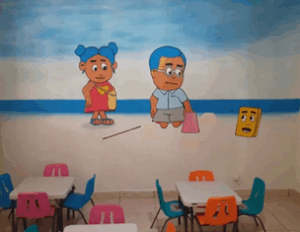 A kindergarten in Haiti painted Blue Butterfly’s original characters on its walls, just like classrooms in the U.S. might feature Elmo or Mickey Mouse.
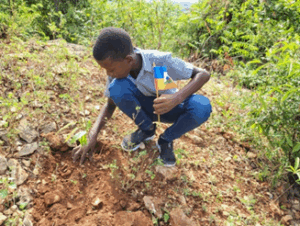
- After watching an environmental video, 100 children planted trees in their community—living testament to learning in action.
- A teacher, inspired by Blue Butterfly’s materials, brought them to a new school and successfully advocated for adoption—proving the model’s staying power.
“These are the moments that affirm what we’re doing,” Cole said with a smile. “When children see themselves in the lessons, when teachers change the way they teach—that’s the true measure of success.”
The Role of TSNE
Since 2013, Blue Butterfly Collaborative has been fiscally sponsored by TSNE. For Cole, the partnership has been pivotal to their ability to focus on mission
“TSNE’s experience in operations allows us to do our work better. You’re good at what you’re good at, and we’re good at what we’re good at. That means I can walk into a funder meeting and say with confidence that our grants will be managed responsibly—because I know TSNE has that expertise.”
This strong operational foundation frees BBC to focus entirely on their mission: creating equitable, inclusive, and joyful learning experiences.
Looking Ahead
In the next five years, Blue Butterfly aims to complete its full preschool through sixth-grade curriculum across all subjects, scale to more schools nationwide, and deepen partnerships with the Haitian Ministry of Education and the Inter-American Development Bank.
While Haiti faces profound challenges, Cole believes in the power of Blue Butterfly’s work to offer hope and possibility.
“Things are very hard in Haiti right now,” she acknowledged. “But we like to believe that our work celebrates the best of the country and provides a positive narrative—something hopeful coming out.”
Learn more about Blue Butterfly’s work: https://www.bbutterfly.org/ and its Lakou Kajou program in Haiti.
Learn more about TSNE’s Fiscal Sponsorship services: https://tsne.org/fiscal-sponsorship/