
TSNE has drawn on staff perspectives, lessons from our ongoing work with partners and clients, and analysis of changing sector conditions to clarify how we can best support nonprofits now and in the years ahead.
What emerged was both urgent and clarifying.
Nonprofits are navigating a convergence of pressures: funding volatility, chronic underinvestment in organizational infrastructure, workforce strain, and growing uncertainty across the social sector. These pressures are not experienced equally. BIPOC-led organizations and historically under-resourced nonprofits continue to shoulder disproportionate burdens while too often receiving the fewest unrestricted resources and the least long-term support.
At the same time, organizations continue to need trusted partners who can help strengthen the systems that make mission work possible: financial management, operations, people practices, leadership, technology, governance, and space.
That is the role TSNE is committed to playing, and the focus that this framework sharpens.
This framework does not represent a change in TSNE’s purpose. It clarifies how we live that purpose: by connecting our services more intentionally, grounding our support in equity, learning from data and partner experience, and using what we learn to strengthen conditions across the nonprofit sector.
A Living Framework for a Changing Environment
As our planning process deepened, it became clear that a traditional, static strategic plan would not be enough for the environment nonprofits are facing. Conditions are shifting too quickly. Instead, TSNE is treating strategy as an ongoing practice: a living framework we use to make choices, learn, adapt, and stay accountable to the organizations and communities we serve.
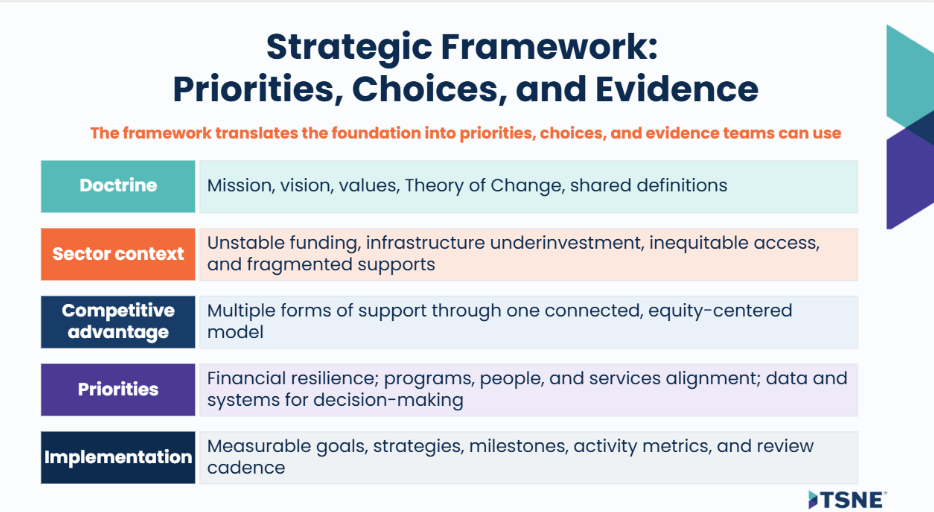
TSNE’s Strategic Framework
A key part of this approach is our updated theory of change:
TSNE advances its mission by providing programs, services, advocacy, and thought leadership that strengthen nonprofit partners’ finances, operations, leadership, and voice. As partners become more sustainable, better supported, and less vulnerable to operational risk, they are better positioned to serve communities, influence systems and policy, and advance a just and equitable society.
As we look ahead, three commitments will guide how this framework shows up in our work and in our partnerships.
Strengthening Nonprofit Infrastructure
Strong nonprofit infrastructure allows programs, services, and community leadership to succeed. Organizations need reliable operations, financial and people systems, data and technology, leadership capacity, governance support, and physical spaces to advance their missions effectively and sustainably.
Too often, these supports are treated as overhead rather than essential capacity. The result is that nonprofits are expected to respond to increasingly complex needs while operating with fragile systems and limited flexible support.
TSNE will strengthen the services, tools, and partnerships that help organizations build long-term capacity and resilience. Through fiscal sponsorship, shared services, consulting and training, property management and services, and advocacy and thought leadership, organizations can enter where they need support most and draw on additional expertise as their needs change.
Deepening Equity-Centered Practice
Equity remains central to how we approach our work. Capacity building cannot be one-size-fits-all, particularly in a sector where structural inequities shape access to funding, staffing, visibility, opportunity, and room to grow.
At TSNE, equity-centered practice means making decisions that reduce structural barriers, widen access, and distribute power. In practice, this includes designing support around partners’ self-determined goals, improving accessibility and responsiveness, and paying particular attention to BIPOC-led, BIPOC-serving, and under-resourced community-based organizations that have faced sustained underinvestment.
It also means continuing to examine our own practices, assumptions, data, and business model in service of aligning operations with our values.
Connecting Services, Sustainability, and Advocacy
The challenges facing nonprofits are not solely organizational; many are shaped by public policy, funding practices, and sector-wide narratives. TSNE will work at both the organizational and systems levels, supporting individual nonprofits while helping to improve the conditions that shape the sector as a whole.
We will use what we learn through direct service to inform advocacy, thought leadership, and sector learning, while bringing emerging needs and sector insights back into our programs and services. We will also create clearer connections across TSNE so that clients and partners can more easily access the breadth of our expertise.
At the same time, we are strengthening how we use data, partner feedback, and outcome measurement to improve services and make better decisions. This internal discipline is not an end to itself. It helps TSNE remain responsive, effective, and reliable for the organizations that depend on us.
What This Means for Our Partners
For current clients and fiscally sponsored projects, this framework signals continuity and a commitment to clearer pathways and stronger coordination across TSNE. It does not signal an immediate wholesale change to services. Instead, it gives us a clearer basis for improving how partners experience and move through our support over time.
For nonprofit leaders, it clarifies the range of support available as organizations grow, stabilize, navigate transitions, or adapt to changing needs. That might mean helping a growing project establish reliable finance and people systems, supporting an organization through a leadership transition, providing mission-aligned space, or connecting leaders to learning and peer support.
For funders and sector partners, the framework reinforces a central truth: durable community impact requires investment not only in programs, but also in the systems, people, leadership, technology, and space that allow nonprofits to deliver those programs well. It also creates a stronger foundation for translating recurring partner challenges into advocacy, policy recommendations, and shared sector learning.
Across all of these audiences, the usefulness of the framework will be measured not by the words on the page, but by whether partners experience TSNE as more connected, responsive, and effective.
Moving Forward Together
Strategy will be meaningful only if it shapes how we make decisions and how partners experience TSNE. In the year ahead, we will share what we are learning, how this framework is informing our services and advocacy, and where we need to adapt.
We know the road ahead for the nonprofit sector will continue to bring uncertainty and complexity. We also know that nonprofits are essential to the health and resilience of our communities, and that investing in their strength, leadership, and sustainability has never been more important.
We are grateful to the board, staff, partners, clients, and community members whose perspectives continue to strengthen our work and our vision for what is possible.
We invite you to explore our full strategy framework, learn more about TSNE’s services, or connect with us about the support that would be most useful to your organization.